
Content Containers & Units
MythTapestry organises your writing into containers (the shelves and binders of your world — books, campaigns, encyclopaedia domains) and content units (the actual pieces of writing inside them — scenes, session notes, articles). Containers can hold other containers, so your structure can be as flat or as deep as your project needs.
The starting structures
Section titled “The starting structures”Every world comes with three ready-made structures. They’re starting points, not rules — see Make the structure your own below.
For novels, novellas, and story collections.
- A book contains chapters, ordered by sequence
- Chapters contain scenes — the individual pieces you write
- A book carries fields like Genre, Status, Target word count, and Story structure (Hero’s Journey, Three Act, Save the Cat, and more)
Campaigns
Section titled “Campaigns”For tabletop and game-oriented worlds.
- A campaign contains sessions, one per sitting at the table
- Sessions contain segments — recaps, encounter notes, and narratives
- Campaigns carry fields like Game system, Setting, Play schedule, and Party level, and support a participants list for tracking your players
Encyclopaedia domains
Section titled “Encyclopaedia domains”For reference-style lore.
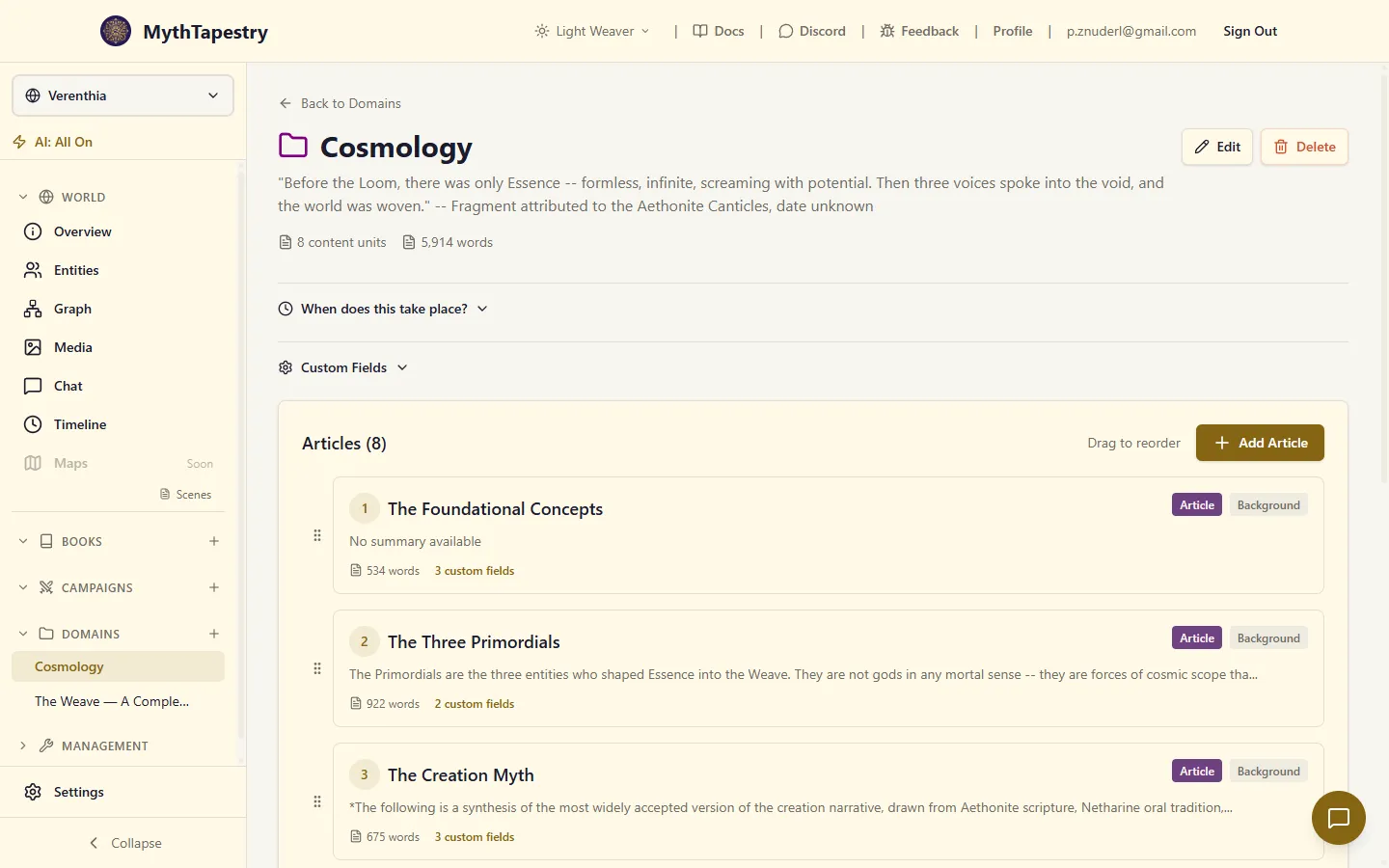
- A domain holds articles directly — no in-between layer
- Domains can also nest inside each other (“History” → “The Sundering Wars”)
- Ideal for topics like Geography, Magic, or Pantheons
Make the structure your own
Section titled “Make the structure your own”The books/campaigns/domains layout is only the default. Structure is driven by type definitions that you can extend from Content Types in the world sidebar:
- Add a level above. Writing a trilogy? Create a Series container type that holds books, and group The Crownfire Cycle’s three volumes under one roof.
- Add a level between. Prefer acts? Create an Act type that sits between book and chapter.
- Add your own piece types. Create an Interlude or Letter content type alongside scenes, each with its own fields.
- Change what the forms ask for. Every container and content type carries a field list. Edit the type — add Point of view to scenes, or Location to sessions — and every create/edit form for that type updates to match. No two worlds need the same shape.
Container fields
Section titled “Container fields”| Field | Description |
|---|---|
| Title | The container’s name |
| Description | A short summary shown on its page |
| Sequence number | Order within its parent — drag to reorder |
| Type fields | Fields from the container’s type (a book’s Genre, a campaign’s Game system) |
| Custom fields | Extra metadata you define per type |
Content units
Section titled “Content units”A content unit is an individual piece of writing — a scene in a chapter, a segment in a session, an article in a domain. This is where your prose lives.
Content unit fields
Section titled “Content unit fields”| Field | Description |
|---|---|
| Title | The unit’s title |
| Content | Your writing, in a full rich-text editor |
| Summary | A short recap — write your own or generate one with AI |
| Narrative importance | Major, minor, or background — how much weight AI features give this piece |
| When does this take place? | The unit’s position on your world’s timeline (see below) |
| Custom fields | Fields from the unit’s content type — a scene’s Scene type or POV character |
Narrative importance
Section titled “Narrative importance”- Major — key scenes, pivotal events, cornerstone articles
- Minor — supporting content, secondary details
- Background — flavour text, ambient details, background lore
The world chat and other AI features use this to decide how much attention each piece deserves when answering questions about your world.
When does this take place?
Section titled “When does this take place?”Each content unit can record when in your world’s history it happens — the coronation scene takes place in Year 512, the prologue thirty years earlier. Settings inherit down a chain, so you only override where needed:
World defaults → this content unit → individual date marks in the textThe panel in the editor sidebar lets you set:
| Field | Description |
|---|---|
| Calendar | Which of your world’s calendars to use (defaults to the world’s primary) |
| Start / End | When this piece begins and ends on the timeline |
| Precision | How exact those dates are — to the day, or only to the season or year |
The editor
Section titled “The editor”Content units open in a full-featured writing environment:
- Text formatting — headings, bold, italic, lists, blockquotes
- Entity mentions — type
@to link a character, place, or faction inline - Date mentions — type
[[to insert a date chip from your calendar - Inline date links — select any phrase and pin a precise date to it (see Inline Temporal Marks)
- AI entity detection — highlights people and places it recognises in your text
- Autosave — your work is saved as you type
Everything you write also feeds your world’s knowledge graph: mentioned entities gain connections you can explore in the graph view, and the world chat can answer questions from your content.
Creating content
Section titled “Creating content”- Open a container — a book, campaign, or domain — from the world sidebar.
- Click Create Chapter / Create Session (or create an article directly in a domain).
- Open the new unit and start writing — it autosaves.
- Optionally set When does this take place? so the piece lands on your timeline.